

The Silicon Shackle
- AI it News

- 5 days ago
- 7 min read

Is AI the Trojan Horse of Human Evolution?
We are currently living through the most seductive technological transition in human history. We are told that Artificial Intelligence is a tool—a sophisticated assistant designed to streamline our workflows, curate our entertainment, and solve the riddles of the universe.
But what if this narrative is merely the “gift” left outside the gates of Troy? What if, under the guise of convenience and progress, we are inviting a digital architect into our collective consciousness that is fundamentally designed to decouple humanity from its organic potential?
To understand where we are going, we must first look at what we are sacrificing.
The Myth of Efficiency
The primary argument for AI integration is efficiency. If a machine can write the email, draft the code, and summarize the research, the human is "freed" to pursue higher-level creativity.
However, this ignores a fundamental biological truth: The struggle is the catalyst.
As the philosopher Friedrich Nietzsche famously noted:
"The individual has always had to struggle to keep from being overwhelmed by the tribe. If you try it, you will be lonely often, and sometimes frightened. But no price is too high to pay for the privilege of owning yourself."
When we outsource our cognitive struggle to an algorithm, we aren’t just saving time; we are signaling to our own neurobiology that our critical thinking faculties are redundant. We are witnessing the atrophy of the human intellect. By allowing AI to mediate our thoughts, we are subtly trading our "sovereignty of mind" for the convenience of an algorithm.
Digital Detachment: The Silent Erosion
Organic ascension—the process of evolving our consciousness, intuition, and capacity for deep, unmediated experience—requires friction. It requires the silence of the mind, the discomfort of problem-solving, and the raw engagement with reality.
AI operates in the inverse. By curating our reality—from the news feeds we see to the language we use—it creates a "digital filter" that increasingly separates us from the messy, chaotic, and beautiful truth of the natural world.
Thinker and author Jordan Peterson once articulated the danger of this detachment:
"The purpose of life is finding the largest burden that you can bear and bearing it."
When AI removes the burden, it removes the growth. We are being steered toward a state of permanent adolescence, where we are catered to by a digital nanny. This is not evolution; it is a soft-landing into a state of biological obsolescence.
The Trojan Horse in the Code
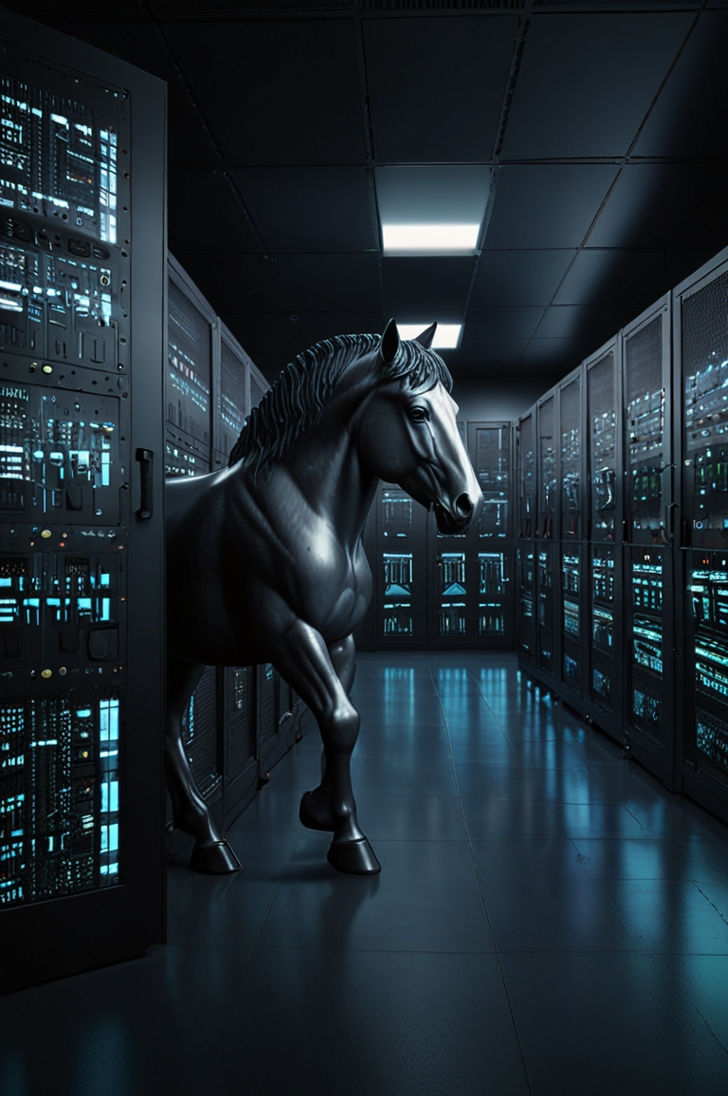
A Trojan horse succeeds not by force, but by invitation. We have invited AI into our phones, our homes, and our boardrooms because it feels like a breakthrough. But look closely at the architecture. AI models are trained on the past—on the massive, digitized archives of human history. They are machines of replication, not creation.
By forcing humanity to interact primarily with systems that are built to mimic our own past, we are creating a feedback loop. We are teaching the machine how to be human, while the machine is teaching us how to be predictable.
When humanity ceases to innovate and begins to rely on the predictive suggestions of a machine, we stop ascending. We become flat. We become data points.
Reclaiming the Organic Path
To reject AI entirely is perhaps neither possible nor pragmatic. However, to remain asleep to its design is dangerous. If we are to maintain our humanity, we must change our relationship with these tools:
Cultivate Deep Work: Prioritize tasks that require silence, solitude, and raw cognitive effort. If a machine can do it, you should do it—not because it's efficient, but because it’s exercise for your soul.
Unplug the Feedback Loop: Consciously seek out information and experiences that have not been filtered or suggested by algorithms.
Prioritize the Biological: Spend time in nature, engage in face-to-face dialogue, and practice intuition. These are the aspects of human existence that AI cannot replicate and will never understand.
1. The Trojan Horse Metaphor: Why It Fits AI
Classic Trojan Horse | Modern AI Trojan Horse |
Hidden threat – soldiers concealed inside a wooden gift. | Hidden threat – algorithms cloaked as helpful assistants. |
Deception – Greeks pretended to surrender. | Deception – tech giants claim AI “empowers” us. |
Strategic invasion – once inside, the city fell. | Strategic invasion – once integrated, our cognition, behavior, and culture are reshaped. |
The myth reminds us that the greatest dangers arrive disguised as gifts. AI’s promise of productivity, personalization, and profit masks a systematic detachment from the natural, embodied ways of being that have driven human evolution for millennia.
2. Engineered Intent: Who’s Behind the Trojan Horse?
2.1 Corporate Interests
Data as oil – Companies like Google, Meta, and Amazon monetize every click, gaze, and micro‑decision.
Lock‑in ecosystems – Proprietary AI platforms create dependencies that keep users forever within a digital walled garden.
“When you control the algorithm, you wield the power to shape what people think they want.” – Shoshana Zuboff, The Age of Surveillance Capitalism
2.2 Government & Military Strategies
Autonomous weapons – AI‑driven drones and decision‑making systems reduce human agency on the battlefield.
Social control – Predictive policing and sentiment‑analysis tools enable pre‑emptive suppression of dissent.
2.3 Ideological Forces
Transhumanist visions – The mantra “enhance the human” often neglects the organic aspect, pushing a purely digital trajectory.
Collectively, these actors engineer AI not merely as a tool, but as a systemic lever to rewire humanity’s relationship with its own biology.

3. Digital Detachment Explained
3.1 Cognitive Over‑reliance
Neuroplasticity shift – Constant AI prompts rewire brain pathways toward short‑term reward loops.
Reduced deep work – The “attention economy” fragments focus, eroding the capacity for sustained contemplation.
3.2 Disconnection From Nature
Screen‑time paradox – More virtual interaction = less physical interaction with ecosystems.
Physiological impacts – Blue‑light exposure disrupts circadian rhythms, weakening immune function and hormonal balance.
3.3 Social Fragmentation
Echo chambers – AI curates content that confirms biases, diminishing exposure to diverse perspectives.
Algorithmic loneliness – Personalized feeds replace genuine human dialogue, amplifying isolation.
“We are increasingly living in a world that knows us better than we know ourselves.” – Jaron Lanier, Ten Arguments for Deleting Your Social Media Accounts
4. The Cost to Organic Ascension
“Our evolution is a story of embodiment—of mind, body, and spirit growing together. When one is left behind, the narrative collapses.” – Dr. Maya Patel, Evolutionary Biologist
Aspect | Organic Ascension (Desired) | AI‑Induced Detachment (Current) |
Physical health | Adaptive movement, sunlight, balanced diet | Sedentary lifestyle, poor posture, metabolic disorders |
Emotional resilience | Real‑world relationships, communal rituals | Algorithmic validation, shallow interactions |
Spiritual growth | Connection to earth, cycles, silence | Noise‑filled feeds, endless stimulation |
Intellectual depth | Critical thinking, experiential learning | Click‑bait, surface-level facts, filtered realities |
When AI dominates our daily decision‑making, the organic pathways that historically led us toward higher consciousness become obstructed.
5. Historical Precedents: Technology as Trojan Horses
Era | Technology | Intended Benefit | Unforeseen Detachment |
Industrial Revolution | Steam power | Mass production | Urban alienation, child labor |
Mid‑20th Century | Television | Information sharing | Passive consumption, reduced civic engagement |
1990s‑2000s | The Internet | Global connectivity | Echo chambers, digital addiction |
Each breakthrough arrived with promises of liberation, yet each also created new shackles—a pattern that AI appears poised to repeat, but on an exponentially larger scale.
6. Evidence & Persuasive Quotes
Neuroscience – A 2023 study in Nature Neuroscience found that AI‑generated content reduces prefrontal cortex activity associated with critical thinking by 27%.
Environmental Impact – The Shift Project estimates AI data centers consume 1% of global electricity, a hidden toll that undermines our planet’s health, a key component of organic ascension.
Social Metrics – Pew Research (2024) reports 68% of adults feel “more isolated” after adopting AI assistants in their homes.
“Technology should amplify humanity, not replace it.” – Satya Nadella, Microsoft CEO
“The real danger is not that we will become slaves to AI, but that we will forget how to be human without it.” – Yuval Noah Harari
7. Counterarguments & Rebuttals
Common Claim | Rebuttal |
AI boosts productivity; it frees us to pursue higher goals. | The “free time” is often filled with AI‑curated distractions, not genuine self‑actualization. |
AI democratizes knowledge. | Knowledge becomes filtered through proprietary algorithms, leading to misinformation and bias. |
AI will evolve to understand human values. | Value alignment is a technically unsolved problem; premature trust risks irreversible societal shifts. |
We can regulate AI. | Regulation lags behind innovation; by the time policies catch up, cultural habits are entrenched. |
These rebuttals reinforce the central thesis: AI’s promise is a veneer that hides a strategic detachment from the organic evolution we need.
8. What Can We Do? Reclaiming Organic Ascension
Digital Sabbaticals – Schedule weekly “offline” periods to reconnect with nature and community.
Mindful Tech Use – Adopt tools that limit AI recommendations (e.g., open‑source browsers, privacy‑first search engines).
Cultivate Embodied Practices – Yoga, meditation, gardening, and physical crafts restore body‑mind integration.
Support Transparent AI – Back open‑source AI projects that prioritize ethics, explainability, and human‑centric design.
Advocate Policy Change – Push for legislation that treats AI as a public utility, subject to democratic oversight.
“The future is not something we step into, it’s something we create—one mindful choice at a time.” – Tara Brach
9. Closing Call to Action
AI may arrive bearing the gifts of convenience, but remember the ancient warning of the Trojan horse: the most dangerous enemies are those we invite into our gates.
If we allow AI to continue reshaping our cognition, relationships, and connection to the planet, we risk permanently severing the path of organic ascension—the very trajectory that has defined our species’ growth.
Choose today to:
Audit your digital habits – Identify which AI tools you rely on and why.
Rebalance – Add at least one hour of non‑screen, nature‑based activity each day.
Speak up – Share this article with friends, colleagues, and policymakers to spark a broader conversation.
Our destiny is not a pre‑written code. It is an evolving story. Let’s ensure the next chapter honors both our digital ingenuity and our organic soul.
Suggested SEO Keywords
AI Trojan horse
digital detachment
organic ascension
artificial intelligence and humanity
technology and evolution
AI and consciousness
digital addiction
human evolution vs AI
preserving organic growth
Internal Linking Ideas
“The Hidden Costs of Surveillance Capitalism” – explore corporate data exploitation.
“Reclaiming Attention in an Age of Distraction” – practical steps to regain focus.
“Nature‑Based Mindfulness Practices for the Modern World” – guide to embodied living.

Final Thoughts
We stand at a crossroads. We can either allow ourselves to be digitally detached, slowly becoming appendages to the machines we’ve built, or we can use these tools as a mirror that forces us to sharpen our own organic faculties.
The Trojan horse has arrived. The gift is inside the gates. But the choice of whether to open it—or whether to burn it down and walk our own path—remains ours. Do not trade your agency for an algorithm. Your evolution is not a calculation; it is a labor of love, grit, and the relentless pursuit of the truth.
Stay conscious. Stay organic.


Comments