

The Keys to the Pleroma
- AI it News

- May 1
- 8 min read
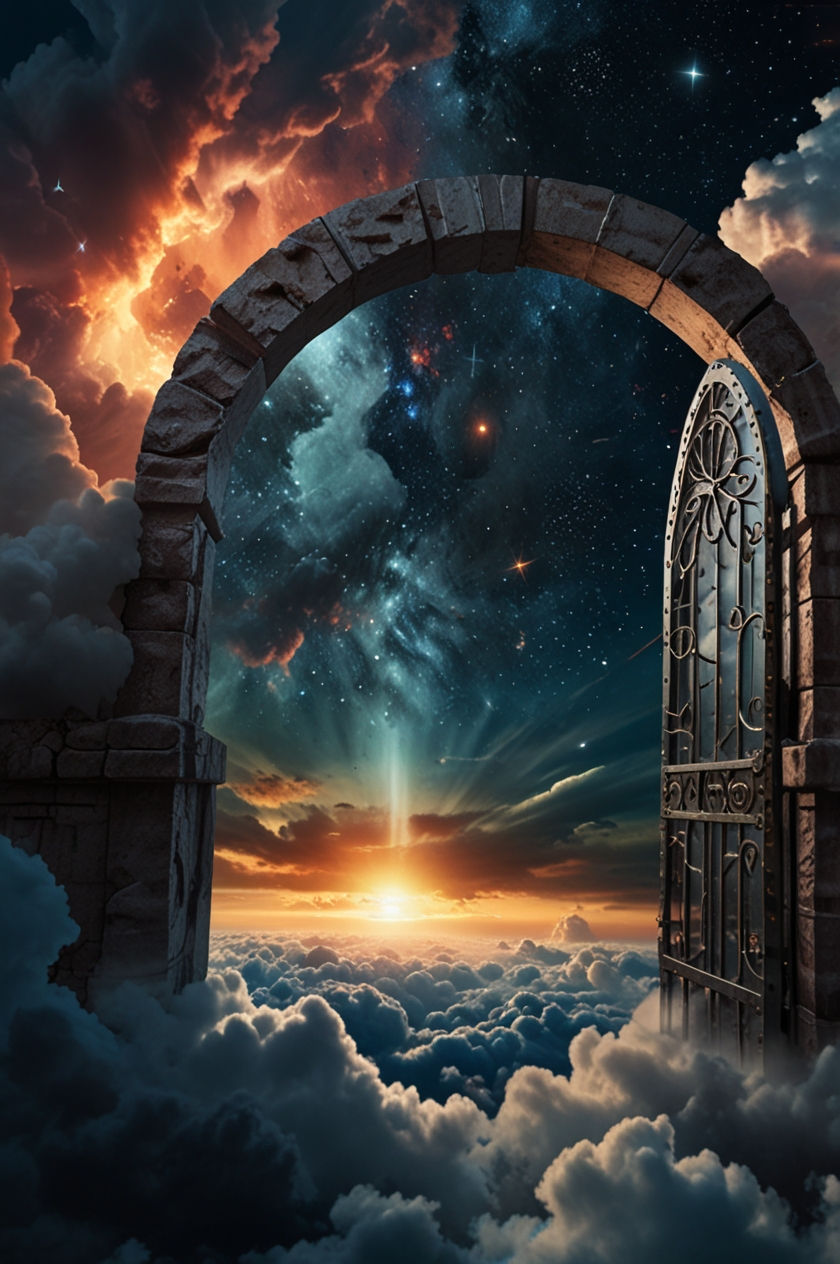
Unlocking the Gnostic Secret Passwords to Heaven
In the quiet corners of the Egyptian desert in 1945, a discovery was made that would shatter two millennia of theological certainty. The Nag Hammadi library, a collection of thirteen leather-bound papyrus codices, didn’t just offer a different perspective on early Christianity; it offered a survival guide for the soul. Among the most startling revelations within these texts is the concept of "Pass-phrases" or "Passwords"—sacred, specific formulas of knowledge required to navigate the afterlife.
To the modern mind, the idea of needing a password to enter "Heaven" sounds like something out of a spy novel or a digital security protocol. But to the ancient Gnostics, this was the most pressing reality of human existence. They believed we were living in a simulated, or at least a flawed, material reality governed by celestial jailers. To return home to the True Light, one didn’t just need to be "good"—one needed to be informed.
If you have ever felt that there is a "glitch in the matrix," or that the systems of this world are designed to keep you small, distracted, and subservient, then the Gnostic path is not just ancient history. It is a clarion call for the sovereignty of your soul.
The Cosmic Prison: Why We Need Passwords
To understand the passwords, we must first understand the architecture of the Gnostic universe. Unlike mainstream orthodoxies that view the material world as a divine creation of a benevolent God, the Gnostics held a more radical—and arguably more honest—view.
They posited the existence of the Demiurge (often identified as Yaldabaoth), a "blind god" or a lesser craftsman who created the physical world out of ignorance or malice. Surrounding the Earth are the Archons (the Rulers), celestial gatekeepers who inhabit the planetary spheres. Their job? To keep the "sparks of divinity"—human souls—from ever leaving the material realm.
As it is written in The Secret Book of John:
"The Archons cast a bond over the human, so that he might be enslaved to them... they made him drink the water of forgetfulness, so that he would not know where he came from."
When we die, the Gnostics believed, our soul begins an ascent. However, this is not a peaceful walk toward a bright light. It is a gauntlet. At each planetary gate, an Archon stands guard, demanding a toll, a justification, and a specific "password" that proves the soul is no longer a slave to the material world.
The Nature of Gnosis: Knowledge as Power
In the Gnostic tradition, salvation is not achieved through "faith" in the sense of blind belief. It is achieved through Gnosis—direct, experiential knowledge of the divine self.
The "passwords" found in texts like The First Apocalypse of James or The Books of Jeu are not just arbitrary magic words. They represent a state of being. To say the password is to demonstrate that you have remembered who you are. If you tell the Archon of the Moon that you are a child of the Father, it is because you have actually realized that truth within yourself.
Persuasion is necessary here: Why should we care about this today? because the "Archons" of the 21st century—the algorithms, the social constructs, the fear-based media, and the rigid dogmas—function exactly like their celestial counterparts. They demand our attention, our energy, and our subservience. Learning the "passwords" is the ultimate act of rebellion.
The Script of the Soul: The First Apocalypse of James
One of the most fascinating "training manuals" for the afterlife is found in The First Apocalypse of James. In this text, Jesus (the Gnostic Revealer) provides James with the specific dialogue he must use when he is seized by the "toll collectors" of the celestial toll stations.
Jesus tells James:
"When you are seized, say to them: 'I am a son, and I am from the Father.' He will say to you: 'What sort of son are you, and to what father do you belong?' Say to him: 'I am from the Pre-existent Father, and a son in the Pre-existent One...'"
The dialogue continues with precision. When asked where he is going, James is instructed to say:
"I am going to the place from which I came, to the place from which I came, to that place I shall return."
Notice the absolute sovereignty in these words. There is no pleading. There is no asking for mercy. There is only a declaration of origin and intent. The "password" is the realization that the soul does not belong to the world of the Archons. It belongs to the Pleroma—the Fullness, the True Light.

The Seven Gates: Navigating the Hebdomad
In Gnostic cosmology, the soul must pass through seven spheres (the Hebdomad), corresponding to the seven known planets of antiquity. Each sphere represents a different level of psychological and spiritual entrapment:
The Moon: The realm of biological growth and decay.
Mercury: The realm of commerce, trickery, and false communication.
Venus: The realm of animalistic desire and lust.
Sun: The realm of the ego and the desire for worldly glory.
Mars: The realm of anger and conflict.
Jupiter: The realm of worldly authority and legalism.
Saturn: The realm of time, limitation, and death.
At each gate, the password is your shield. To pass Saturn (the final and most difficult gate), one must prove they have transcended the illusion of time itself.
In the Gospel of Mary, we see Mary Magdalene describing the soul's ascent and its confrontation with the "Seven Powers of Wrath." The soul speaks to the Fourth Power:
"What binds me has been slain, and what turns me about has been overcome, and my desire has been ended, and ignorance has died."
The password, in this context, is the evidence of a life lived in spiritual wakefulness. You cannot use the password if you are still "drunk" on the desires of the world. You must be "sober."
The Science of Sound and Vibration
Critics might argue that "passwords" are mere superstition. However, if we look at this through a more philosophical or even a proto-scientific lens, the concept takes on a deeper meaning.
Nature is composed of frequencies. Ancient traditions across the globe—from the Vedic mantras to the Pythagorean "Music of the Spheres"—suggest that specific sounds and words possess the power to alter reality. The Gnostic passwords may have been viewed as "resonance keys."
By speaking the specific formulas found in texts like the Pistis Sophia, the Gnostic was attempting to tune their soul’s frequency to match the Pleroma, effectively making them "invisible" or "untouchable" to the lower vibrations of the Archons. It is a spiritual stealth technology.
The Modern Archons: Why Gnosticism is Growing Today
We live in an age of unprecedented "capture." Our data is harvested, our opinions are curated by AI, and we are increasingly trapped in a "filter bubble" that mimics the Gnostic "world-bubble."
The persuasive power of Gnosticism lies in its diagnosis: You are in a system designed to forget itself.
The password of Identity stops you from defining yourself by your job title or your bank account.
The password of Origin stops you from believing you are merely a biological accident.
The password of Intent stops you from drifting through life as a passive consumer.
As the Gospel of Thomas famously records:
"If you bring forth what is within you, what you bring forth will save you. If you do not bring forth what is within you, what you do not bring forth will destroy you." (Gospel of Thomas, Saying 70)
The passwords are not just for the moment of death; they are for the "waking death" we inhabit every day.
The Hidden Power of the "Books of Jeu"
For those who want to see how complex and "technological" Gnostic ritual became, one must look at the Books of Jeu. These texts contain intricate diagrams, "seals," and strings of vowels (like I-E-O-U-A) that look more like computer code than traditional scripture.
These were the "Secret Passwords" in their most literal form. The Gnostics would meditate on these sounds, believing they were the specific acoustic keys needed to bypass the "Treasuries of the Light." While this may seem esoteric, it highlights a fundamental Gnostic truth: The universe is governed by laws, and those who understand the laws can transcend them.
Practical Gnosis: How to Prepare Your "Passwords"
How does a modern person apply the wisdom of the Gnostic passwords? It begins with a process of dis-identification.
Recognize the Gatekeepers: Identify the forces in your life that demand your fear or your mindless obedience. These are your personal Archons.
Develop Your Shield: The password is the truth of your nature. When the world tells you that you are "not enough," your password is the internal realization of your divine spark (the Ennoia).
Practice Presence: The Archons thrive on the past (regret) and the future (anxiety). The "Pleroma" is found in the eternal "Now."
Study the Texts: Engagement with the Nag Hammadi scriptures is not an academic exercise; it is a resonance practice. Reading the Gospel of Philip or the Trimorphic Protennoia begins to retune the mind away from the material "matrix."

The Sovereignty of the Soul
The ultimate persuasion of the Gnostic path is that it puts the "keys to the kingdom" back into the hands of the individual.
In mainstream religions, you are often a "petitioner," begging for entry from a judge who sits outside of you. In Gnosticism, you are a "sovereign," reclaiming a birthright that was stolen. You don't ask for permission to enter Heaven—you recognize that you are of Heaven, and therefore, the gates must open.
The password is not a secret kept by a jealous God; it is a secret hidden by your own amnesia.
As the Gospel of Truth states:
"Ignorance... brought about anguish and terror. And the anguish became dense like a fog, so that no one could see. Thus error became powerful... It set to work on its own matter, foolishly, not having known the truth."
To speak the password is to clear the fog. It is to say, "I see you, Error. I see you, Archon. And you have no power over me."

The Final Ascent
The Gnostic "Heaven" is not a place with golden streets and pearly gates. It is the Pleroma—a state of absolute fullness, consciousness, and unity. The secret passwords are the tools of the spiritual revolutionary. They are the refusal to be a "resource" for a predatory cosmic system.
We are living in a time of great unveiling. The old structures of meaning are crumbling. In this transition, the ancient Gnostic voice returns to whisper in our ears: You are not who they told you you are. You are greater than the world that contains you. Remember the passwords. Remember the way home.
The journey to the Pleroma does not begin at the moment of death. It begins the moment you decide that you will no longer be a slave to the "blind god" of materialism. It begins when you look at the gatekeepers of this world and speak the truth of your origin.
Do you have your passwords ready?
Key Quotes to Remember:
"The soul that has been saved is the one that has found its passwords." — (Traditional Gnostic Saying derived from the Books of Jeu)
"I am a pearl, I am a spark, I am the son of the Unbegotten." — (The Naassene Fragment)
"Become passers-by." — (Gospel of Thomas, Saying 42)
Suggested Further Reading:
The Nag Hammadi Library (Edited by James M. Robinson)
The Gnostic Religion by Hans Jonas
The Gnostic Gospels by Elaine Pagels
The Pistis Sophia (G.R.S. Mead Translation)
1874 wordsgemini-3-flash


Comments