

The Book of the Law
- AI it News

- 17 hours ago
- 8 min read

Unveiling the Esoteric Bridge Between Moses and Aleister Crowley
Few texts in human history carry the intoxicating, controversial, and paradigm-shifting weight of Liber AL vel Legis, universally known as The Book of the Law. Dictated in Cairo over three consecutive days in April 1904 by a preterhuman intelligence named Aiwass to the self-proclaimed "Great Beast 661," Aleister Crowley, this short, cryptic manuscript serves as the foundational holy text of Thelema.
Yet, beneath its modern veneer of occult rebellion and the infamous maxim—"Do what thou wilt shall be the whole of the Law"—lies a profound, highly sophisticated esoteric commentary on the roots of Western spirituality. Specifically, Crowley framed his revelation not as the eradication of the past, but as the ultimate fulfillment and evolution of the ancient Mosaic tradition.
To truly understand The Book of the Law, one must explore the labyrinthine bridge connecting Moses, the great lawgiver of the Hebrew Bible, and Aleister Crowley, the radical prophet of the Aeon of Horus. This comprehensive guide unpacks the historical, magical, and philosophical intersections between these two titanic figures of religious history.
1. The Genesis of a Revelation: Setting the Stage
To appreciate the weight of The Book of the Law, one must look at the psychological and magical crucible from which it was born. In the spring of 1904, Aleister Crowley and his newlywed wife, Rose Kelly, were holidaying in Cairo, Egypt. Rose, who had previously shown no interest in the occult, suddenly entered a series of mild trances and began repeating a startling phrase: "They are waiting for you."
Intrigued, Crowley—a seasoned mountaineer, chess player, and initiate of the Hermetic Order of the Golden Dawn—tested his wife. He asked her to identify the specific god waiting for him. Rose, guided by an unseen intelligence, walked through the Boulak Museum and pointed directly to a painted wooden funeral stele from the 26th Dynasty: The Stele of Revealing.
Coincidentally (or synchronously), the museum catalog listed this artifact under the exhibit number 666.
[Sidebar: The Stele of Revealing]
Depicting the Egyptian funerary god Ra-Hoor-Khuit (a manifestation of Horus) receiving offerings from the deceased priest Ankh-af-na-khonsu, the Stele became the visual anchor for Crowley’s new dispensation. It represented the transition from the old passive eras of spirituality into an active, fiery new aeon.
Between noon and 1:00 PM on April 8, April 9, and April 10, 1904, Crowley sat at a writing desk and heard a voice dictating from over his right shoulder. The entity identified himself as Aiwass, the "minister of Hoor-paar-kraat" (Harpocrates, the Lord of Silence). The result was the 220-verse manuscript that would change Western esotericism forever.
2. The Mosaic Blueprint: Lawgivers and Tablets
Why invoke Moses when discussing a text channeled by an eccentric 20th-century occultist? Because Crowley himself insisted upon the parallel. In his Confessions and various magical papers, Crowley explicitly positioned himself as a modern-day Moses—a liberator delivering a new set of tablets to a humanity emerging from spiritual bondage.
The Parallel of the Mountain and the Desert
Consider the archetypal journey of the lawgiver:
Moses retreated to the desolate heights of Mount Sinai, fasting for forty days and nights to commune with the Divine and receive the tablets inscribed by the finger of God.
Crowley retreated to the bustling, sun-baked isolation of Cairo—a gateway between the deserts of North Africa and the ancient mysteries of the Nile—to receive a transmission meant to shatter old paradigms.
Both figures acted as human conduits for cosmic legislation. While Moses brought forth the Torah (Law) characterized by covenant, commandments, and moral restriction, Crowley brought forth a law designed to dismantle those very restrictions in favor of individual divine sovereignty.
"Do what thou wilt shall be the whole of the Law." — The Book of the Law (I:40)
Crucially, Crowley noted that just as Moses had to break the first set of tablets (symbolized by the Golden Calf incident) because the Israelites were not ready for the raw power of the unvarnished truth, humanity in 1904 was only just beginning to decode the blistering frequencies of The Book of the Law.

3. Decoding the Text: Nuit, Hadit, and Ra-Hoor-Khuit
The Book of the Law is divided into three chapters, each corresponding to a distinct theological principle personified by the deities of the Egyptian pantheon. These figures map remarkably well onto the esoteric undercurrents found within Mosaic mysticism and Kabbalah.
Chapter I: Nuit (The Infinite Space)
Associated with the night sky, infinity, and the ultimate feminine principle of potential, Nuit represents the boundless possibilities of the universe. In the context of the Mosaic tradition, Nuit can be seen as the ultimate Ain Soph—the limitless, unknowable divine essence that existed before creation.
"Come ye aside, o ye children, under the stars, & be filled with my joy." — The Book of the Law (I:12)
Chapter II: Hadit (The Infinite Point)
The complement to Nuit, Hadit is the core of every star, the central point of consciousness, movement, and the masculine principle. He is the serpent of incandescent light, echoing the brazen serpent (Nehushtan) that Moses raised in the wilderness to heal the Israelites.
"I am the secret Serpent coiled about to spring: in my coiling there is joy. If I lift up my head, I and my modern soul are one. If I droop down mine thighs, and emit the music, then is earth of the earth." — The Book of the Law (II:26)
Chapter III: Ra-Hoor-Khuit (The Crowned and Conquering Child)
The active, aggressive manifestation of the sun and force. Ra-Hoor-Khuit is the god of the new Aeon—an era characterized not by self-sacrifice, suffering, and guilt (symbolized by the dying god archetype of Osiris or Jesus), but by strength, creativity, and the realization of one’s True Will.
4. The Theological Shift: Moving Beyond the Old Aeon
To understand why The Book of the Law is so persuasive to modern seekers, one must examine its critique of the "Old Aeon"—the spiritual epoch dominated by the worship of sorrow, which Crowley associated directly with the Judeo-Christian heritage inherited from figures like Moses.
In Crowley’s view, the Mosaic Law served a vital evolutionary purpose for its time: it bound a fragmented, tribal people together under a strict moral code, fostering social cohesion and monotheistic discipline. However, by the dawn of the 20th century, that system had become obsolete. The rituals of sacrifice, self-denial, and obedience to external authorities had birthed a civilization of neurosis, world wars, and spiritual stagnation.
The Book of the Law declares the end of this epoch with chilling finality:
"The old spells are shrunken. He that is a bosomed dancer in my house shall not pass away. The weak shall perish in their misery; for they shall not be as they are. Pity not the fallen! I never knew them. I am not for them. I console not: I hate the unconsoled and the dead." — The Book of the Law (II:21)
This passage often shocks casual readers. Critics point to it as evidence of cruelty or social Darwinism. However, from a persuasive esoteric perspective, these lines are not a call to literal violence against the weak; rather, they are a psychological diagnosis. The "weakness" condemned here is the internal surrender of one's sovereignty—the refusal to discover and execute one’s True Will.
In the Mosaic paradigm, humanity looked up to an external lawgiver on a mountain. In the Thelemic paradigm introduced by Crowley, humanity looks within, recognizing that every man and every woman is a star.
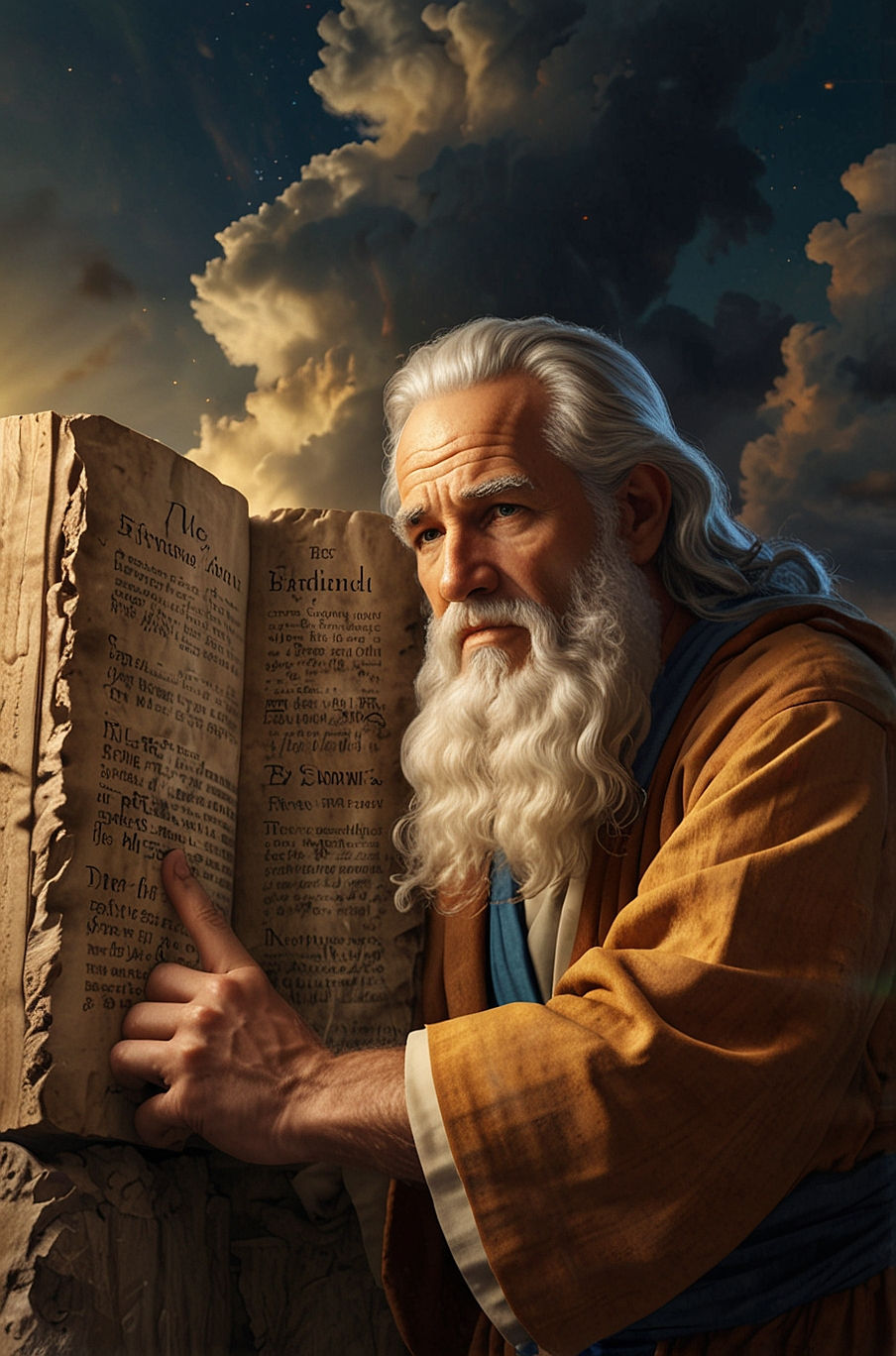
5. The True Will vs. The Ten Commandments
The ultimate friction—and the most fascinating bridge—between Moses and Crowley lies in the nature of "Law."
The Mosaic Commandment: Thou Shalt Not
The Ten Commandments are largely restrictive, operating on a negative matrix of prohibition: Thou shalt not kill, thou shalt not steal, thou shalt not covet. They assume a baseline of human depravity that requires external policing.
The Thelemic Law: Do What Thou Wilt
Conversely, The Book of the Law introduces a radically affirmative directive:
"Do what thou wilt shall be the whole of the Law." — The Book of the Law (I:40)
Followed immediately by:
"Love is the law, love under will." — The Book of the Law (I:57)
To the uninitiated, "Do what thou wilt" sounds like a recipe for hedonistic chaos. But Crowley was meticulous in his commentaries (such as The Law is for All and Magick Without Tears). "Wilt" does not mean whim, ego-driven caprice, or the satisfaction of temporary desires. It refers to the True Will—the individual's unique, cosmic trajectory, aligned perfectly with the harmonic structure of the universe.
[Comparison Table: The Two Dispensations]
+--------------------------+-----------------------------------+-----------------------------------+
| Feature                  | The Mosaic Tradition              | The Thelemic Tradition            |
+--------------------------+-----------------------------------+-----------------------------------+
| Source of Authority      | External Deity (God / Yahweh)     | Internal Divinity (The Star/Self) |
| Core Orientation         | Obedience, Morality, Covenant     | Discovery and Execution of Will   |
| View of Human Nature     | Fallen, requires external law     | Inherently divine, seeking growth |
| Primary Metaphor         | The Slave of God                  | The Independent Sovereign Star    |
+--------------------------+-----------------------------------+-----------------------------------+
6. The Kabbalistic Subtext: Bridging East and West, Old and New
Aleister Crowley was not an isolated eccentric inventing ideas in a vacuum; he was a master scholar of the Western Mystery Tradition, deeply well-versed in the Hebrew Kabbalah. Throughout The Book of the Law, gematria (the Jewish system of assigning numerical values to Hebrew letters) is used to embed cryptographic seals within the text.
For example, the number 418, known as the number of the Great Work and the word Abrahadabra, is woven into the fabric of the text. Similarly, the central number 93 (representing Thelema [Will] and Agape [Love]) governs the entire philosophy.
By utilizing the scaffolding of Hebrew mysticism—the Tree of Life, the Tarot, and the Hebrew alphabet—Crowley consciously built upon the foundations laid by ancient scribes and prophets like Moses. He did not destroy the esoteric language of the past; he translated it into a modern, dynamic key.
As Aiwass dictated:
"The word of Sin is restriction. O man! refuse not thy wife, if she will! O lover, if thou wilt, depart! There is no bond that can unite the divided but love: all else is a curse. Hell: bind notu! Cull ash! Truth all-glorious! Behold! the attainments of the phallus, or the ostentation of the os rotundum." — The Book of the Law (I:41–42)
7. Common Misconceptions and Controversies
No discussion of The Book of the Law is complete without addressing its notoriety. For over a century, sensationalist media, religious fundamentalists, and internet commentators have distorted Crowley’s teachings.
Misconception 1: "It promotes selfishness and immorality."
Reality: Thelema demands an intense level of personal discipline. Aligning with one's True Will requires cutting away illusions, confronting inner psychological shadows, and respecting the sovereignty of others (since every man and every woman is a star). True Will is harmonious, not destructive.
Misconception 2: "It is an anti-Semitic or anti-Christian hate tract."
Reality: While Crowley violently rejected the puritanical dogmas and institutional corruptions of the churches of his era, his philosophy is fundamentally ecumenical. He drew heavily from world religions—including Hinduism, Buddhism, Gnosticism, and Kabbalah. His critique of Moses was institutional, not racial; it was a critique of the "Slave-God" mentality wherever it manifested.
8. Why The Book of the Law Matters Today
In the 21st century, humanity finds itself in the throes of another monumental paradigm shift. Traditional religious institutions are experiencing historic declines, scientific materialism has left a vacuum of meaning, and individuals are desperately searching for authentic spiritual frameworks that honor both personal freedom and cosmic interconnectedness.
The Book of the Law speaks directly to this modern existential crisis. It challenges us to abandon borrowed beliefs and step into the blazing responsibility of self-discovery.
"The word of the Law is Thelema." — The Book of the Law (I:39)
Whether viewed as a direct transmission from an angelic intelligence, a manifestation of Crowley’s subconscious genius, or a continuation of the eternal lineage of lawgivers stretching back to Moses on Mount Sinai, The Book of the Law remains an inescapable monument of modern spirituality.
Ascending Your Own Mountain
Moses brought the tablets down from Sinai to unite a tribe in the desert. Aleister Crowley transcribed The Book of the Law to awaken sovereign individuals in a technocratic world.
The journey from the Mosaic Aeon of obedience to the Thelemic Aeon of liberty is not a rejection of spiritual heritage, but its ultimate distillation. It invites every seeker to stop looking for lawgivers on distant mountains, to look within the sacred chamber of their own heart, and to answer the ultimate, empowering question posed by the text:
What is your will?
Recommended Further Reading
The Book of the Law (Liber AL vel Legis) with the Commentaries of Aleister Crowley.
The Equinox (The official organ of the A∴A∴).
Aleister Crowley: The Biography by Tobias Churton.
The Law is for All by Aleister Crowley and Israel Regardie.


Comments