

The Alchemist's Furnace

Unlocking the Hidden Secrets of Nature, Art, and Transformation
“Nature does not begin her secrets in heaven. She hides them in stone, root, blood, fire and flesh.”
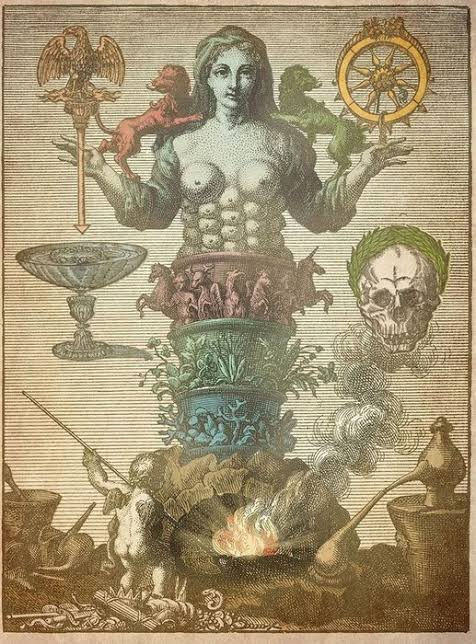
Imagine standing before an ancient printing press in Stockholm, the year is 1712, and the air smells faintly of ink, damp paper, and woodsmoke. Your eyes fall upon the frontispiece of Swedish physician and chemist Urban Hjärne’s Actorum Chymicorum Holmiensium. It is an intricate engraving—a visual riddle crafted from ink and imagination, designed to stop the casual observer dead in their tracks.
This is no ordinary illustration. It is a portal into a forgotten worldview.
At first glance, the engraving feels alien, weighed down by archaic symbols and mythological motifs. But look closer. It lays bare a profound philosophy that bridges the gap between the physical world and human consciousness. It is an artistic manifesto of alchemy, a silent teacher instructing the beginner in one of the universe's most guarded secrets: the relationship between Nature and Art.
In this comprehensive exploration, we will decode this 18th-century masterpiece. We will journey through the kingdoms of stone and root, stand beside the roaring furnace of the alchemist, and discover why true transformation has nothing to do with turning lead into gold—and everything to do with awakening the hidden possibilities sleeping within matter itself.
Part I: The Mother of All Kingdoms — Decoding the Multi-Breasted Figure of Nature
To understand the engraving, we must first look to its apex. Dominating the upper portion of the imagery is a striking, unconventional figure: a woman with many breasts, standing as the undisputed sovereign of the cosmos.
To the modern eye, this imagery can be jarring. To the historical alchemist, it was instantly recognizable as Nature personified (often associated with the goddess Artemis of Ephesus or the broader archetype of Natura).
"That is the mystery this engraving places before the student of alchemy. The many breasted woman is Nature herself, feeding every kingdom from one inexhaustible source."
Why many breasts? The symbolism is as visceral as it is brilliant. Nature is the ultimate wet nurse. She does not hoard her resources; she pours them out continuously, sustaining every living thing from a singular, inexhaustible matrix of being.
Beneath her, the engraving maps out the Great Chain of Being. Minerals rise upward into plants; plants absorb minerals and, in turn, sustain animals. The entire composition forms a magnificent, vertical ladder. This is not a static hierarchy, but a dynamic continuum. It illustrates a single, unified creative power—a divine current taking on increasingly complex forms as it ascends from the dark, silent depths of the earth into the light of sentience.
Flanking this great mother are lions. These are not passive beasts of burden; they are crackling with raw energy.
"The lions beside her express the fierce generative strength that drives this process."
Nature is not polite, gentle, or tame. She is an engine of relentless creation and destruction. She is the wild, untamed impulse behind the splitting seed, the erupting volcano, and the pulsing heartbeat. She creates because creation is her very nature.
Yet, for all her power, Nature keeps her deepest secrets locked away. She doesn't flash them across the sky; she buries them. As the opening quote reminds us, her secrets are hidden “in stone, root, blood, fire and flesh.” If you want to know her, you have to get your hands dirty.
Part II: The Labor Below — The Alchemist and the Furnace
If the upper half of the engraving represents the divine, wild blueprint of the cosmos, the lower half represents human agency.
Shift your gaze downward, past the great ladder of kingdoms, past the magnificent beasts, and look at the bottom of the frame. There, tucked away in the shadows of the laboratory, sits a small human figure tending a brick-built furnace.
This diminutive figure represents Art.
In the lexicon of alchemy, "Art" (Ars) did not mean painting a canvas or sculpting marble. It meant human craft, applied technology, and the disciplined manipulation of physical elements. It is the work of the alchemist.
Crucially, the engraving establishes an immediate boundary between Nature and Art. The alchemist is small; Nature is vast. The human operator cannot bully, command, or legislate reality into existence.
"The alchemist cannot command Nature to become something she is incapable of becoming."
You cannot force an oak tree to grow out of a handful of sand, nor can you extract gold from a substance that holds no metallic potential. Nature sets the rules of the game. She holds the boundaries of possibility.
So, what, then, is the role of the alchemist? If Nature does all the work, why tend the furnace?
The answer lies in catalysis.
"Instead, through fire, vessels, separation, purification, and recombination, Art helps hidden possibilities already sleeping within matter to emerge."
Nature is pregnant with potential, but much of that potential remains trapped, sluggish, or obscured by crude matter. A lump of ore in the earth is rich with metal, but it is bound up in slag, oxides, and impurities. Left to geological time, it might transform over millennia—or it might remain buried forever.
The alchemist accelerates this timeline. Through the deliberate application of heat (fire), containment (vessels), breakdown (separation), cleansing (purification), and synthesis (recombination), Art acts as an intellectual mid-wife. The alchemist does not create gold or medicine out of nothing; rather, they strip away the chaos that keeps pure potential from expressing itself. They coax the hidden flower out of the stubborn seed.
Part III: The Stripping of Vanity — Crowns, Coins, and Swords in the Dust
Before we move deeper into the philosophical implications of this 1712 frontispiece, we must examine a striking detail scattered across the floor of the laboratory.
Look closely at the base of the furnace. Lying discarded in the dirt are crowns, minted coins, swords, and various emblems of worldly authority and status.
Why are they there? What are royal crowns and bags of money doing in a dusty alchemical workshop?
The engraving makes a fierce, uncompromising statement about the pursuit of truth:
"Before Nature, wealth and rank teach nothing. The true treasure is knowledge of transformation."
Humanity is obsessed with artificial hierarchies. We bow to kings, trade our lives for coins, and measure our worth by the length of our swords. We build entire social structures around power, lineage, and accumulation.
To Nature, these things are absolute nonsense.
A crown holds zero weight in the crucible. A pile of gold coins cannot accelerate the melting point of lead by a single degree. A sword cannot cut through the metaphysical density of ignorance. When you stand in front of the furnace—when you face the raw, unyielding reality of elemental matter—your social title vanishes. Nature does not care if you are a duke or a peasant; she demands the exact same price from everyone: focused attention, patient labor, and profound humility.
This is a powerful cautionary tale for the beginner. Alchemy was never truly about getting rich quick (despite the popular caricature of the medieval charlatan trying to manufacture get-rich-quick gold). The discarded symbols of wealth are a deliberate rejection of worldly greed. They tell the student: Leave your ego at the door. If you enter this laboratory seeking mere power or riches, you will find only ash.
The only currency that matters here is insight. The only authority is the mastery of change.
Part IV: The Great Synthesis — Nature and Art as Partners
To truly grasp the genius of Urban Hjärne’s 1712 frontispiece, we must resolve the apparent tension between its two halves. Is creation the work of the wild, untamed goddess above, or is it the methodical labor of the small artisan below?
The answer is both. They are two halves of a single engine.
Think of it as an ancient partnership. Nature supplies the seed. She provides the raw, unrefined potential—the chaotic prima materia. She provides the laws of physics, the genetic codes, the atomic weights, and the elemental affinities. Without Nature, Art has nothing to work with; it is an engine without fuel, a mind without a body.
Conversely, Art prepares the conditions. Nature is often wasteful, slow, and indiscriminate. Seeds blow into barren rocks and die; metals remain locked in toxic matrices; diseases ravage the body before natural immunities can catch up. Art steps in to curate the environment. It builds the closed vessel (the vas hermeticum), regulates the temperature of the fire, and protects the fragile process from external contamination.
Through this collaborative dance, transformation occurs.
"The engraving therefore gives the beginner one of alchemy’s greatest lessons: Nature supplies the seed, Art prepares the conditions, and transformation reveals what was secretly possible from the beginning."
This principle is not restricted to chemistry or physical metallurgy. It is a universal law of being.
Consider how this applies to human life:
In Education: Nature supplies the raw intelligence, temperament, and innate capacities of a child (the seed). Art (teaching, discipline, mentorship, and structured study) prepares the conditions. Education does not stuff a mind with foreign facts; it draws out (e-ducere) what was already latent within.
In Psychology and Healing: Nature provides the emotional baseline, the biological drives, and the inherent capacity for self-healing. Art (psychotherapy, mindfulness, self-reflection, and inner discipline) creates the safe, contained "vessel" of the therapeutic space. Through the "fire" of emotional honesty and the "separation" of unhelpful behavioral patterns, the integrated self emerges.
In Art and Creativity: Nature provides inspiration, sensory perception, and emotional depth. Art provides the grueling, methodical practice, the brushwork, the revision, and the structural discipline required to turn a fleeting feeling into a timeless masterpiece.

Part V: The Alchemical Journey of the Soul
While Urban Hjärne was a physician and chemist—a man deeply entrenched in the emerging scientific rationalism of the Enlightenment—his frontispiece retains the deep, spiritual footprint of esoteric tradition.
In the traditional alchemical framework, the transformation of physical metals was simultaneously an allegory for the transformation of the human soul. The "Great Work" (Magnum Opus) was an internal journey divided into distinct phases that mirror our engraving:
Nigredo (The Blackness / Separation): Just as the alchemist grinds down minerals and breaks them apart with fire and acid, the inner journey requires us to dismantle our false identities, our egos, and our comforting illusions. It is the dark night of the soul, represented in our engraving by the chaos of the lower laboratory and the discarded crowns of false pride.
Albedo (The Whiteness / Purification): Once the impurities are burned away, a purification takes place. The dross is separated from the pure essence. The mind becomes clear, calm, and receptive to deeper truths.
Cubitudo / Citrinitas & Rubedo (The Redness / Recombination): The final stage where the purified elements are reunited in a higher, perfected state. The gold is born. The human consciousness is transmuted.
Notice how the engraving illustrates this spiritual ascent vertically. The eye is pulled from the chaotic floor, past the humble furnace, up through the ascending kingdoms of stone, plant, and animal, until it rests upon the multi-breasted figure of Nature.
The alchemist begins in the dirt, tending a mundane fire, but his work ultimately connects him back to the divine maternal matrix of the universe. By mastering the small, base elements of the physical world, the human operator touches the infinite.
Part VI: Why 1712 Matters Today
You might ask: Why should a modern reader care about an obscure 18th-century copperplate engraving published in Stockholm? We live in an age of quantum mechanics, artificial intelligence, and instantaneous digital communication. Surely, alchemy is a dead pseudoscience, a quaint historical stepping stone on the path to modern chemistry.
In terms of laboratory technique? Yes, alchemy has been superseded. We no longer use alembics to distill morning dew or search for the philosophers' stone to cure physical mortality.
However, in terms of philosophy, meaning, and our relationship to the natural world, we desperately need the wisdom of the 1712 frontispiece.
Today, humanity suffers from a profound disconnect from Nature. We treat the natural world either as a resource to be plundered (reminiscent of the greed symbolized by the discarded coins and crowns) or as something entirely separate from us, a pristine wilderness to be visited on weekends rather than a living matrix of which we are an inextricable part.
Urban Hjärne’s engraving offers a powerful corrective. It reminds us that:
We are part of the ladder. We are not masters standing outside of Nature; we are the latest, most complex rung on a ladder that stretches down into the very stones beneath our feet.
Technology (Art) must serve Nature, not dominate her. The alchemist does not conquer Nature; he listens to her, respects her boundaries, and works with her grain. When human artifice forgets this partnership—when we try to command Nature to become things she is incapable of becoming—we invite ecological and existential catastrophe.
True value is internal. In a hyper-materialistic culture obsessed with status symbols, social media metrics, and financial wealth, the engraving’s message rings louder than ever: Crowns and coins lie in the dust. The only true treasure is the inner realization of your own hidden potential.

Tending Your Own Furnace
As we close this exploration of An Allegory of Chemistry and Nature, return for a moment to the visual center of the piece. Picture the tiny alchemist in the dim light of the Stockholm workshop. He is kneeling before his bricks. He is stoking the flames. He is watching the glass vessel, waiting patiently for the colors to shift, for the precipitate to settle, for the secret to reveal itself.
He does not rush the process. He knows that Nature cannot be hurried. He knows that the seed will sprout when the time is right, provided he has done his work with diligence and care.
We are all alchemists in our own lives. Every time we sit down to learn a difficult skill, to heal a broken relationship, to process grief, or to bring a creative vision into physical reality, we are standing before the furnace.
We bring our raw material—our flaws, our talents, our confusion, our passion. We bring our art—our discipline, our patience, our daily labor. And somewhere in the quiet space where human effort meets the wild, inexhaustible generosity of the cosmos, transformation happens.
Remember the wisdom of the 1712 frontispiece: Nature supplies the seed, Art prepares the conditions, and transformation reveals what was secretly possible from the beginning.
Now, step into your workshop. Stoke your fire. And see what secrets are waiting to be uncovered in the stone, root, and flesh of your own life.


Comments